Published on 28 September 2026 · 11 min read
Making your own espresso with a portafilter machine
A portafilter machine does less for you than a bean-to-cup, and that is the point: everything the machine does not do, you do, which means you can do it better. The first few weeks are often disappointing all the same. That is rarely the machine and almost always three things — the grinder, the ratio and the filter basket. Below is the order in which to tackle them.
The grinder matters more than the machine
This is the unwelcome part, which is why it comes first. If the choice is between a pricier machine with pre-ground coffee and a simple machine with a decent grinder, the second wins without argument. Espresso needs a grind you can adjust in small steps, and a bag of pre-ground cannot offer that by definition.
The reason is physical. You are pushing water at roughly nine bar through a puck of seven grams or more in twenty-five seconds. How fine the grounds are decides how much resistance that puck offers, and therefore how long the water is in contact. Pre-ground coffee has exactly one grind, and the odds it happens to be yours are poor.
Ground coffee also goes flat quickly. The difference is noticeable within fifteen minutes, and it is not a subtlety — it is a clear step backwards.
- A grinder with a real grind adjustment beats a more expensive machine.
- Grind per shot, immediately before brewing.
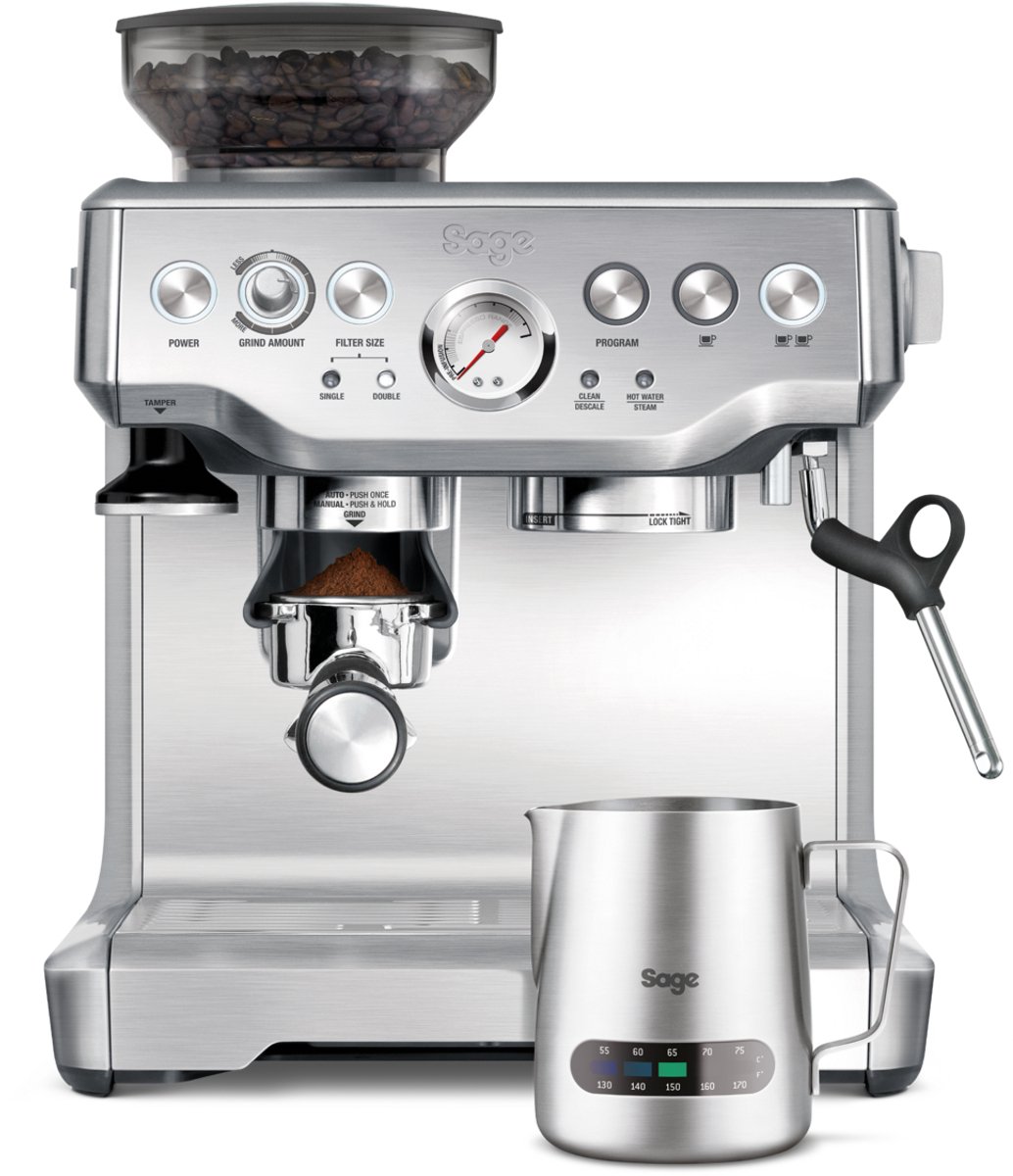
- Machines with a grinder built in make this decision for you — see the models below.
The recipe: dose, time, yield
Espresso is not an art, it is a ratio, and that ratio is the only thing you need to remember. Weigh what goes in, weigh what comes out, and time how long it takes.
The usual starting point for a double: eighteen grams of dry coffee in the basket, thirty-six grams of liquid in the cup, in twenty-five to thirty seconds from the moment the pump starts. That is a 1:2 ratio. With a smaller basket, keep the ratio rather than the absolute numbers.
Note that yield is in grams, not millilitres. Crema is foam, so a cup that looks full can hold far less coffee than you think. A kitchen scale accurate to a tenth of a gram is the cheapest real upgrade this hobby has.
- In: 18 g. Out: 36 g. Time: 25–30 seconds.
- Change one thing at a time, or you will not know what did it.
- Write down what you do for the first few weeks. Your memory lies about this.
The basket decides whether you get a say
Many entry-level machines ship with a pressurised basket — double-walled, with one small hole underneath. That hole creates the back pressure itself, so even coarse supermarket coffee comes out with crema on top. For someone without a grinder that is a perfectly good safety net.
It has one consequence that rarely makes it onto the box: because the basket creates the pressure, your grind matters far less. You can grind as fine as you like and the shot runs much the same. Everything below about adjusting the grind therefore barely applies.
To actually steer the shot you need a single-walled basket — a sieve with hundreds of holes, where the coffee puck itself provides the resistance. Most machines include one in the box. Look at the underside: hundreds of holes is single-walled, one hole is pressurised.
- One hole underneath: the basket decides, not you.
- Hundreds of holes: the coffee decides, and therefore you do.
- Start pressurised if you have no grinder yet. Switch the day you get one.
The grind is the only dial you really turn
With a single-walled basket and a fixed dose, the grind is your steering wheel. Shot running too fast, grind finer. Too slow, grind coarser. You need no other control, and turning several at once is the fastest way to lose the thread.
Move in small steps. One click on a stepped grinder is often already visible in the time; on a stepless one a few degrees is enough. Throw away the first few grams after every adjustment, because old coffee ground at the previous setting always stays behind in the grinder.
Expect it to take a few days. The beans move too: fresh beans are still degassing and run faster than the same beans will two weeks later. That is normal and does not mean you are doing something wrong.
Dosing, distributing, tamping
Weigh the dose into the basket rather than eyeballing it. Two grams out on eighteen is over ten percent, and you can taste it.
Then break up the clumps and level the grounds. Freshly ground coffee falls in little heaps, and where it sits looser the water runs through faster — that is channeling, and it is the most common reason a shot tastes watery and bitter at the same time. A needle, or a paperclip bent straight, stirred briefly through the grounds, removes almost all of it.
Tamp after that: straight down, firm enough to set the puck, and above all level. The exact kilos matter far less than a decade of internet argument suggests; tamping at an angle matters enormously, because water always finds the thin side.
Wipe the rim of the basket before you lock it in. Grounds on the rim keep the gasket from sealing and it will start to drip in time.
- Weigh the dose. Every time.
- Stir the clumps out before you tamp.
- Level tamping beats hard tamping.
Reading the shot
Put a cup on the scale, start the pump and the timer together, and watch. First drops should appear after five to eight seconds. After that you want an even, syrupy stream that starts dark and slowly pales.
Coffee within two seconds and done in fifteen means the grind is too coarse or the dose too low. Nothing for thirty seconds and then a drip means too fine or too high. Either way: one step, try again.
If one jet runs noticeably faster or paler than the rest, or it sprays sideways, that is channeling. The grind will not fix it; better distribution and a level tamp will.
Stop at your target weight, not on the clock. The time is a check, the yield is the goal.
Tasting: sour is not the same as too strong
The two mistakes you make early on are opposites, and they are the ones most often confused.
Sharp, sour, salty, a little hollow at the end: too little has come out of the coffee. That is under-extraction. Grind finer, or run it longer to a slightly higher yield.
Bitter, drying, smoky, with a tongue that still feels scoured a minute later: too much has come out. Over-extraction. Grind coarser, or stop earlier.
The confusing part is that a fast shot often seems to be both — watery and bitter. That is usually not an extraction problem but channeling: part of the puck has been exhausted while the water bypassed the rest. Look at your distribution first, not your grinder.
Steaming milk with a wand
For cappuccino and flat white you want microfoam: milk with bubbles so small it shines and pours like wet paint. Large bubbles and a stiff cap of froth are a different thing and do not fold into the coffee.
Purge the wand first to blow out the condensed water. Then set the tip just under the surface, open the steam fully, and find the soft hiss that draws air in. You only do that for the first few seconds — after which you sink the wand deeper and the milk should turn in a whirlpool that breaks the bubbles down.
Stop around sixty degrees. Without a thermometer: the jug is then just too hot to hold comfortably. Past seventy, milk starts tasting cooked and the sweetness does not come back.
Wipe the wand immediately and purge it again. Milk left to dry inside a steam wand is hard within a day and smells within two.
- Cold whole milk is easiest; a cold jug helps too.
- Draw air in only at the start, then just mix.
- Tap the jug and swirl it until it shines before you pour.
Cleaning, and how often
Coffee oil goes rancid, and rancid oil turns up in every cup after it. This is the least enjoyable part and it buys more flavour than most accessories do.
After every shot: knock out the puck, rinse the basket, wipe the wand. A quick flush with the portafilter empty rinses the residue off the shower screen.
Weekly: soak the basket and the portafilter in hot water with a detergent made for coffee oil. The colour of the water explains why this is necessary.
Descale periodically, depending on your water hardness. Whether your machine can also take a chemical cleaning cycle with a blind basket varies by model — it depends on the valve arrangement inside, and it is in the manual. Do not guess at that one.
What you do not need to buy
The order in which this gear actually helps is short: a scale, a decent grinder, fresh beans, a single-walled basket. After that it falls off quickly.
A needle for distributing your grounds costs almost nothing and does more than an expensive tamper. A tamper that fits your basket properly is pleasant; a tamper with a spring in it solves nothing that tamping level does not also solve.
Bottomless portafilters are a diagnostic tool, not an improvement: they show channeling beautifully, but they do not make better coffee once you know you do not have any.
And the biggest return is still beans roasted last month rather than last year. That costs nothing extra, only a different place to buy them.